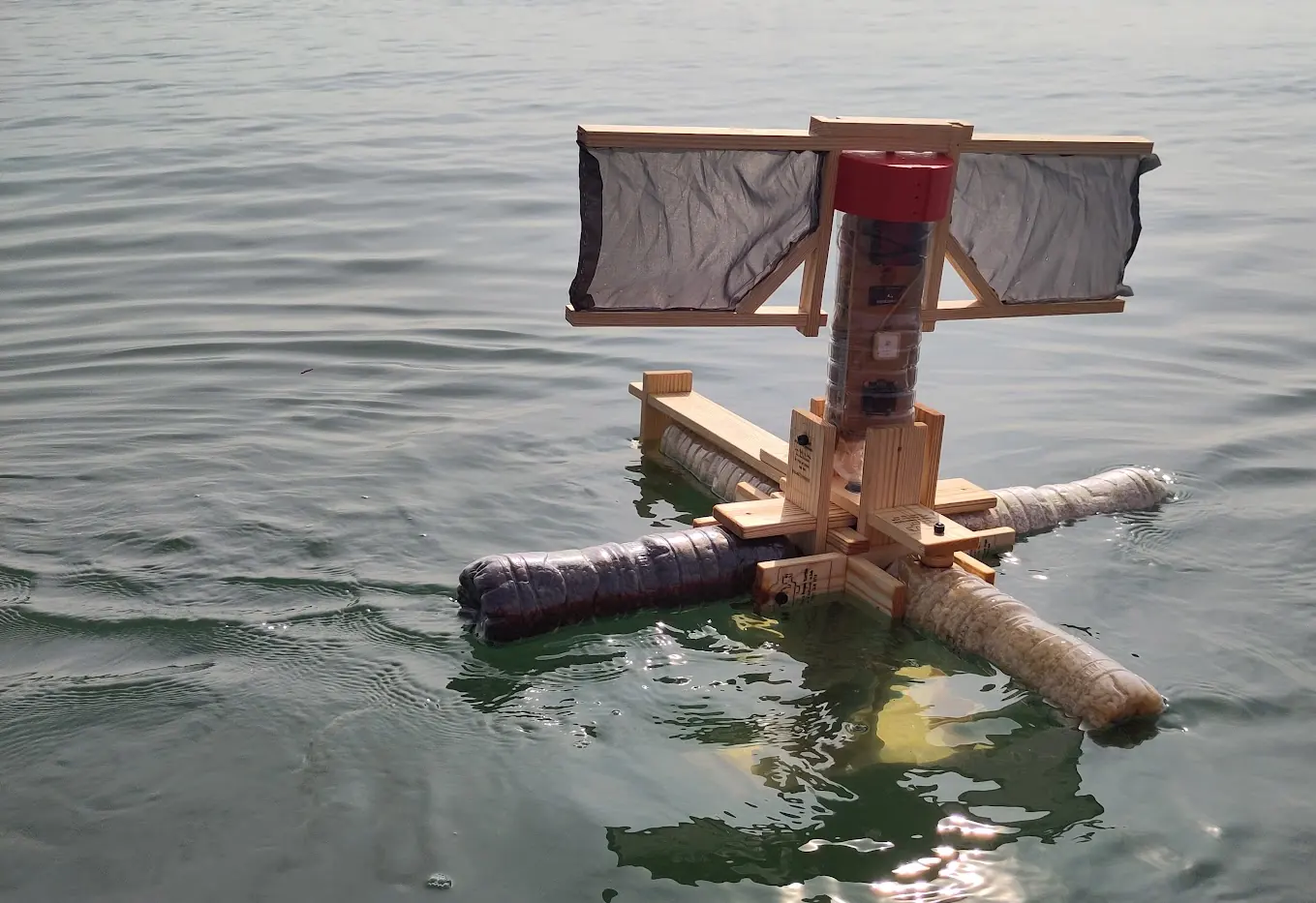
What exactly is a Hope Turtle?
Hope Turtles are a way for anyone, anywhere, to grab local materials and build a marine vehicle that can self-navigate across water to a designated target zone, delivering food and building materials along the way.
To keep the raw cost of a turtle as low as possible, we've gone out of our way to use locally available materials, simple assembly, and readily available electronics. We've also made every plan and design that makes up a Hope Turtle open source — and better yet, we host an online turtle generator, where you can automatically generate the build files you need to make your own.
Built from bottles
Like real-life turtles, Hope Turtles come in all shapes and sizes — because they're built with bottles, and bottles come in all shapes and sizes too. Bottles are everywhere in the world today, and though we take them for granted, they're a minor miracle: lightweight, and remarkably good at carrying things while sealing them airtight. As we strive to get much-needed food and medicine to our fellow humans around the world, bottles are ideal for keeping their contents safe.
The v1 Turtle Design
The core concept of a floating, navigable hope turtle is simple — while our principles are foundational.
This means, following our Earthen design principles, your imagination is the limit on what an actual turtle can look like!
To get started though, after extensive marine testing, we've landed on our v1 core structural design for the Hope Turtle: wood slats and generic 1.5-litre bottles. This keeps us at our goal of having a 95% organic turtle and it keeps assembly and replicability as straightforward as possible. The v1 design uses plain wood slats that are easy for carpenters or CNC machines to cut. There are no moving parts in the body itself. The resulting apparatus holds five 1.5L bottles of food, aid, or medicine, plus one "control bottle" that contains the entire sail-servo, navigation-control, and power-management apparatus in one place.
But our v1 turtle design does more than just deliver food and medicine.
Inspired by the Global Ecobrick Alliance's work developing "ecojoiners" to facilitate bottle construction, we've taken their concept and implemented it into the heart of our v1 turtle.
Ecojoiners were developed by the Global Ecobrick Alliance as a means of assembling bottles into cubic matrices that can be used to build all sorts of things. Ecojoiners have been used with bottles to build chairs, tables, shelves, and more — and we're also very excited about their use as a lattice for earth building, to reinforce cob and adobe structures.
Four projects, four repositories
The Hope Turtle Project is made up of four main components. Each has its own GitHub repository, where we maintain and freely share the source code for the project.
The Turtle Body
This is the geometric design of the turtle's body — the structure that holds the bottles. We've taken our CAD files and distilled them into parametric code, which basically means the entire design of the turtle is like one big equation, where the specifics of any bottle determine the size of its various wood slats. That way, right on this site, you can enter the specifics of your bottle and the system will generate the 3D model, carpentry, CNC, and 3D-print files you need to make your turtle.
View on GitHubThe Turtle Shell
What's silicone, green, and solid? A turtle shell... and a printed circuit board! That's what we affectionately call our PCBs — the boards that connect the microcontroller, sensors, and power together to run the turtle. Every component we've used is easy to find, off-the-shelf, and inexpensive: you can source them from online electronics markets in just about any country for under $30, or have the PCB itself printed by any online service for about $5. Soon, you'll even be able to order the PCB directly from us — we're printing them in batches.
View on GitHubTurtleOS
We've developed, from the ground up, a navigation system to run our turtles: TurtleOS. With a single terminal command, you can install it on any off-the-shelf Xiao ESP32-S3 and be up and running with your turtle in no time. TurtleOS orchestrates the onboard sensors, lets you pick a destination, and sets your turtle swimming. It uses the microcontroller's on-board wifi to connect via API to hopeturtles.org — so with a free account, you can track and monitor your turtle's progress.
View on GitHubHopeTurtles.org
This site is open source too! We've put the full code stack up on GitHub for collaborative development. Our site — gratefully hosted by DewaWeb in Indonesia — is what you're using right now. With a free Buwana account, you can sign up and log in to manage your turtles, and connect bottles, missions, boats, and more. This is also where our turtle generator lives, connecting directly to the Turtle Body's programmatic geometry so you can generate your own turtle based on your local bottles and wood.
View on GitHub